
Poughkeepsie Previous Residents by Address
Previous residents of a Town of Poughkeepsie address leave different kinds of evidence in different eras. A current parcel card supplies the parcel key and deed reference. The County Clerk index connects that reference to a recorded transaction. Historical deed books and letter indexes carry the ownership trail farther back. Directories, census schedules, obituaries, and maps help distinguish past households from the chain of owners. Each source answers a narrower question, so the best result comes from comparing dates, municipality, street number, and legal description.
| Source | Years It Covers | Where Held | What It Shows |
|---|---|---|---|
| County Clerk deed index | July 7, 1907-December 31, 1988; January 1, 1989 to present | Dutchess County Clerk online search | Recorded parties, document details, liber and page, deed image |
| Historical grantor-grantee index | Pre-computerized deed and mortgage material | County Clerk historical search and deed books | Municipality, party role, surname letter, liber, and page |
| Poughkeepsie directory holdings | 1843-45 fiche; 1846 to present project statement; later film runs | NYS Library, Adriance, and DCHS | Dated names, addresses, and household clues |
| Federal census schedules | Released under the 72-year rule; 1950 is the newest fully open schedule | Library and archival census resources | Household composition and place at a census date |
| Sanborn map item | 1913, republished 1952 | Library of Congress | Building footprint, street context, and use |
Start with the parcel when the question concerns one fixed address. Start with directory and obituary material when the address is old, uncertain, or possibly in the City rather than the Town. A Town permit or property-search file is a manual fallback for construction and permit history; no public online permit-case index was located.
Poughkeepsie Parcel Records and Owners
ParcelAccess is the first bridge from a street address to the documents that may identify earlier owners. Search in the Town of Poughkeepsie municipality by address, owner name, or parcel lot. The parcel card can show the parcel number, physical location, owner, primary owner mailing address, land use, assessment, school and agricultural district fields, tax code, and deed book and page. Copy the parcel number, deed reference, legal description, and roll date into the research notes before opening the document index.
Dutchess County Clerk Document Search is the official index for using the parcel card's deed information with municipality, party, date, and document-type filters.
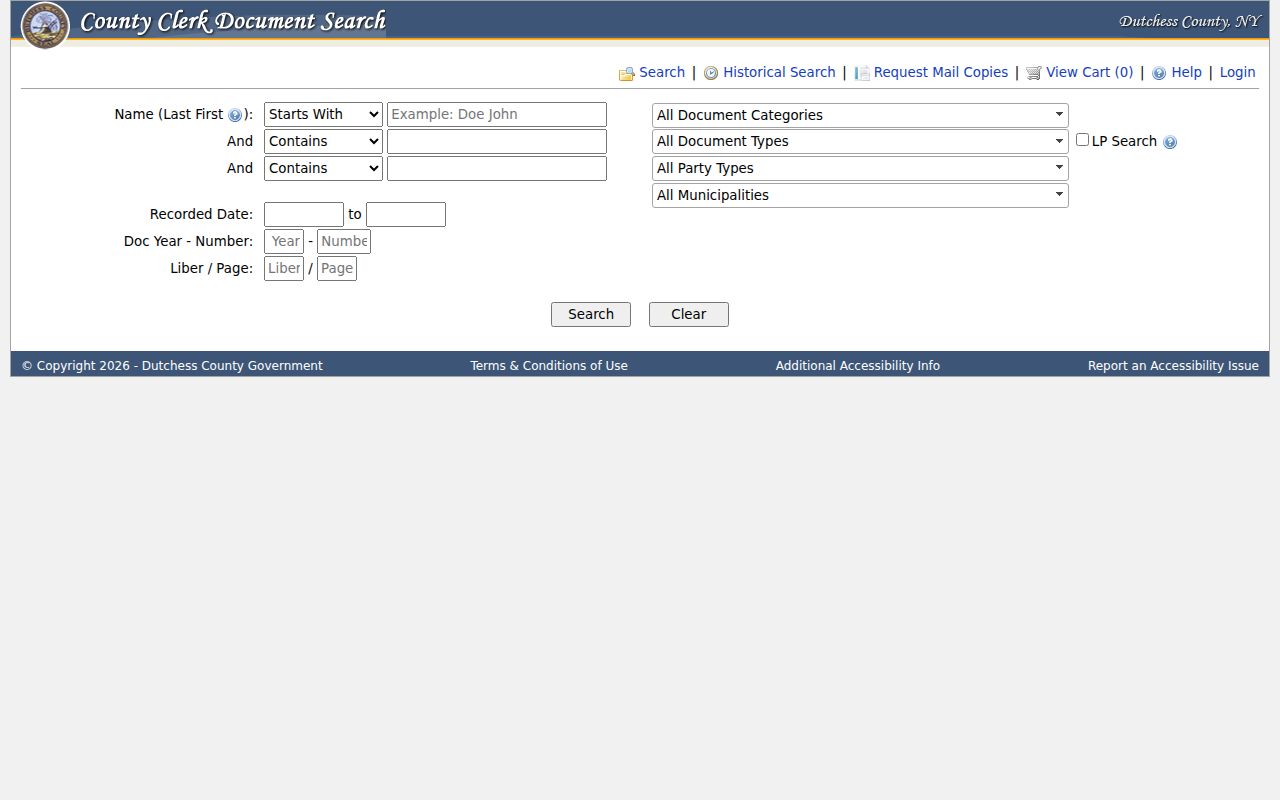
The form's municipality and party-type choices help keep Town of Poughkeepsie deeds apart from similarly named City records and unrelated document roles.
The physical parcel address, tax mailing address, and legal description are not interchangeable. Situs means the physical parcel location. A mailing address can point to an agent, a post-office destination, or another residence. For a Town of Poughkeepsie parcel, the legal description, often a lot, block, metes-and-bounds description, or earlier deed reference, is the stronger key when an older street number no longer matches the modern address.
Poughkeepsie Deed Index Eras
Dutchess uses more than one deed-search method because the record system changed over time. The public document portal separates the deed series beginning July 7, 1907 from the computerized series beginning January 1, 1989. Mortgages have a related 1981-88 and 1989-forward split. These dates mark a change in search method, not the beginning of Town of Poughkeepsie land ownership. The County Clerk has kept land and legal filings since 1715, and older transitions can require the historical index, deed books, a County Clerk request, or an in-person records-room visit.
In the current portal, search a name in last-first order and narrow with Town of Poughkeepsie, a date range, party type, document type, year or document number, or liber and page. The system accepts partial names and normalizes punctuation, spaces, and capitalization. A result should still be checked against its date, municipality, legal description, complement name, and party role before it is attached to a property trail.
Free image views carry an unofficial watermark. Watermark-free portal copies, mailed copies, certified copies, and office searches use different County Clerk fee paths. Exhibits or supporting papers can require a mail route, so the online image is not always the last access channel.
Note: Treat the online image as an index lead when an exhibit or supporting paper requires the County Clerk's mail or records-room route.
Tracing Poughkeepsie Previous Residents
A deed chain is an ownership trail, not a complete list of who lived at an address. It is still the most stable way to move backward through a Town of Poughkeepsie parcel because each purchase deed identifies a seller and preserves a legal description. The sequence changes direction at each transfer: find the current owner as grantee, then find that seller as an earlier grantee. Preserve the same parcel and legal-description clues at every step, especially when a street name or number has changed.
- Search ParcelAccess for the Town address and record the current owner, parcel number, deed book and page, parcel location, and legal description.
- Find the purchase deed in the County Clerk index using the owner as grantee, Town of Poughkeepsie, the likely date, and deed type.
- Read the deed image for the grantor, recording date, legal description, and any detail that ties it to the parcel.
- Search that grantor as a prior grantee in an earlier period, then repeat while the parcel description remains consistent.
- When the computerized trail stops, switch to the historical letter index, note liber and page, and retrieve the deed or request County Clerk help.
- Grantor
- The party transferring an interest in a deed.
- Grantee
- The party receiving that interest in a deed.
- Chain of title
- The dated sequence of recorded transfers connected to the same parcel or legal description.
- Legal description
- The parcel-defining language in a deed, which can remain useful after a street address changes.
Poughkeepsie Historical Deed Letters
For older Dutchess material, the historical grantor-grantee workflow begins with municipality, party type, and a surname letter rather than a modern blank-box search. Select Town of Poughkeepsie, choose grantor, grantee, mortgagee, or mortgagor as the document requires, then open the letter index. The index exposes later surname letters as the researcher moves through pages. Record the liber and page, choose deed or mortgage, enter the reference, and inspect the Town of Poughkeepsie document.
The County Clerk's historical document-search instructions show the municipality, party, surname-letter, liber, and page method.
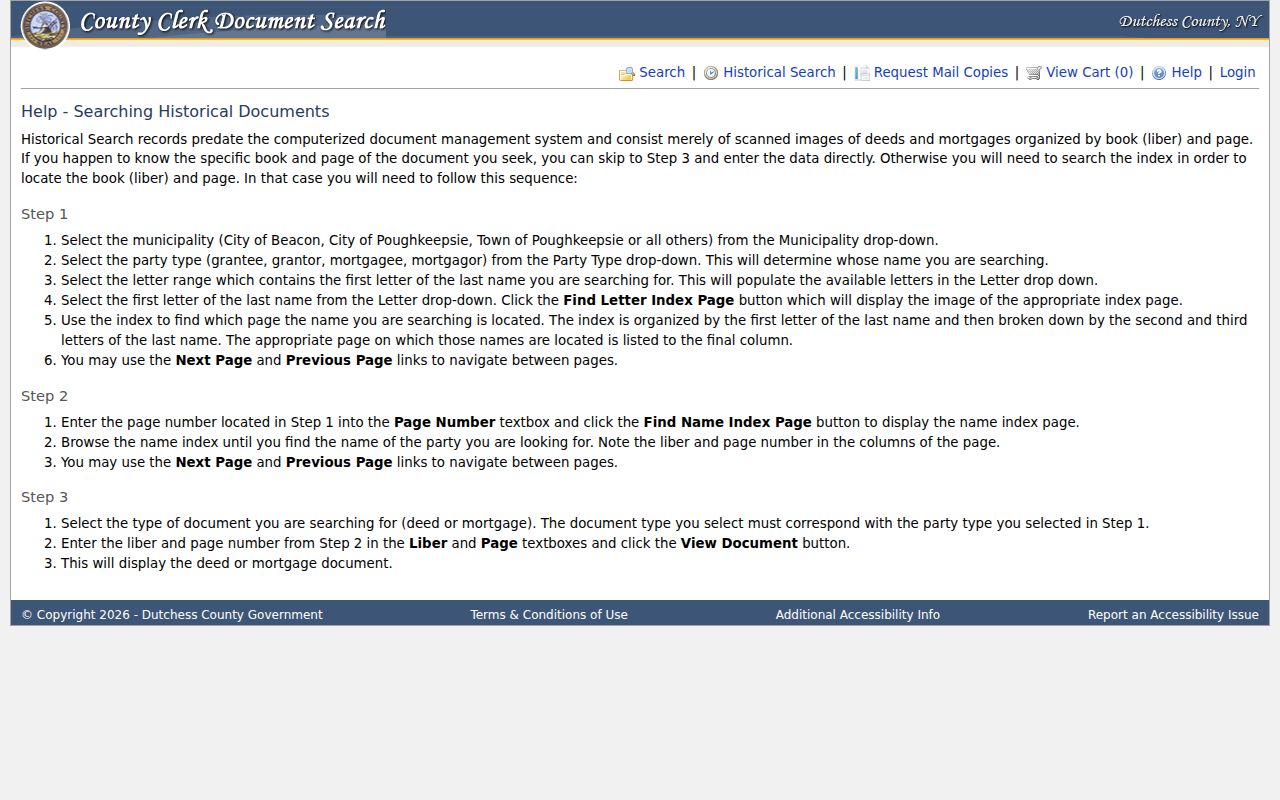
This letter-and-liber workflow is the required next step when a present-day deed search no longer reaches the transfer being studied.
Note: A party name may be a grantor, grantee, mortgage party, lien claimant, or other document participant, so it needs the deed type and parcel context.
Poughkeepsie Ancient Address Leads
When a house history reaches beyond the deed series, Dutchess County's Ancient Documents collection can provide a dated person, place, record type, or document-number lead. The collection reaches from 1721 into the 1840s, while the related MacCracken Index covers 1721–1800. It is not an address directory, but a name or historical legal matter can point to a scan that supplies an earlier description, locality, or relationship to test against land and court records. Record the document number and the source date before connecting it to a modern parcel.
Dutchess Ancient Documents offers the name, city, record-type, offense, year, and document-number fields used to narrow an early-record search.
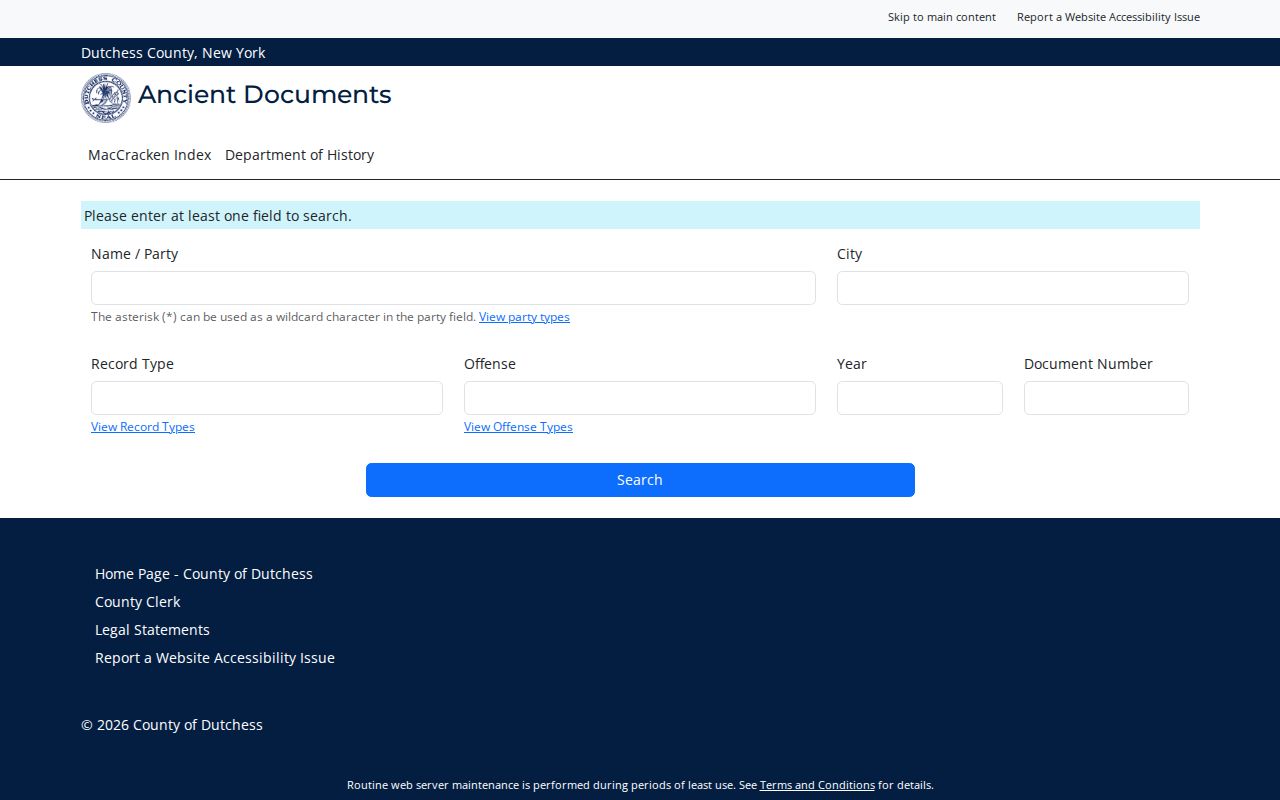
The 2024 collection resource connects local examples to document numbers and original scans. Treat that image and index result as the opening of a source trail, not evidence that a particular person lived at the later street address.
Poughkeepsie Directory Years and Gaps
Ownership alone cannot answer who lived here before. Town of Poughkeepsie directories are annual snapshots that can add an address, spouse notation, occupation, firm, or an owner and renter symbol from the publisher's key. Search the year of a recorded transfer, then the volumes immediately before and after it. A former owner may remain at the address, move elsewhere, or disappear from the listing. A new household at the address may be a useful lead, but it requires a second source.
The 1843-45 State Library fiche and Adriance's 1846-forward project statement are different documented runs, not a contradiction to hide. The relevant volumes, publisher, scope, and missing years should be recorded. Detailed collection holdings and entry-reading practices are available in the Town of Poughkeepsie Directory Book, while this address trail uses those volumes to test a specific transition.
Adriance provides local-history questions by telephone, mail, and email and limits obituary requests to three per request. DCHS provides a locator and finding aids for directories, yearbooks, obituaries, maps, organizations, and newspapers. Those routes are the alternative when a volume or a companion record is not online.
Note: Write down the Town or City jurisdiction beside every Poughkeepsie directory entry before treating it as evidence for the address.
Poughkeepsie Past Residents and Census
Pair directory years with census years to move from a listed name to a dated household record. The process is simple but needs restraint: a directory near a census year suggests an address to test, and a census household can confirm who was recorded there on the census date. Begin with the directory entry closest to the census, compare address spelling and number, then examine the Town of Poughkeepsie directory volumes on either side. Use the 1900 through 2010 schedules as they are available under the release rule, with 1950 the newest fully open schedule in the usual sequence.
After a household leaves the address, Adriance's obituary index and newspaper microfilm can supply a death notice or later locality. For an estate transition, Dutchess Surrogate's Court may have probate material about fiduciaries or heirs, subject to court access rules. A later deed from an estate can explain why the ownership chain changed, but it does not prove every family relationship without the supporting probate or vital-record evidence.
Lawful personal use. Use past-resident research for family history, estate questions, and house history. Never use a record trail to harass, follow, or expose a living person.
Poughkeepsie Sanborn Address Checks
The Poughkeepsie Sanborn item is a useful test before deciding that an older number marks the same structure. The Library of Congress describes a 1913 survey republished in 1952, with 100 sheets covering Poughkeepsie and surrounding places including Arlington, Fairview, Hyde Park, Rudco, and part of the Town. The sheets can show a building footprint, use, material, outbuildings, street name, and fire-risk setting. They cannot identify every previous resident.
The Library of Congress Sanborn map item is the source for testing the structure and street context against a dated directory or deed.
Use the map with the parcel's legal description and a recorded date. That combination can separate a change in a building or street layout from a change in household, which avoids overstating what the address alone proves.
Poughkeepsie Street Name History
A failed old-address search may be a name or boundary problem rather than a missing person. DCHS documents an 1801 street-naming ordinance context and identifies Young Street as a 1924 memorial name for World War I private Giovanni Iondoli, with spelling and name variants. DCHS maps range from 1780 through 1929. Search the older label, the honored person's name where relevant, and the parcel's subdivision or legal description before ending a Poughkeepsie address trail.
Town and City jurisdiction must be checked at the same time. A Poughkeepsie city directory or city genealogy record may not include a Town event or road. The County Clerk municipality field, ParcelAccess municipality, and the historical source's introduction provide safer geographic checks than a postal place name alone.